Advanced Implementation
Here is an explanation of the advanced implementation of CI/CD, using more detailed treatments and tooling.
main acts the same as in root, build and test treatments are from advanced.mel file and contains CI/CD implementation.
CI/CD implementation
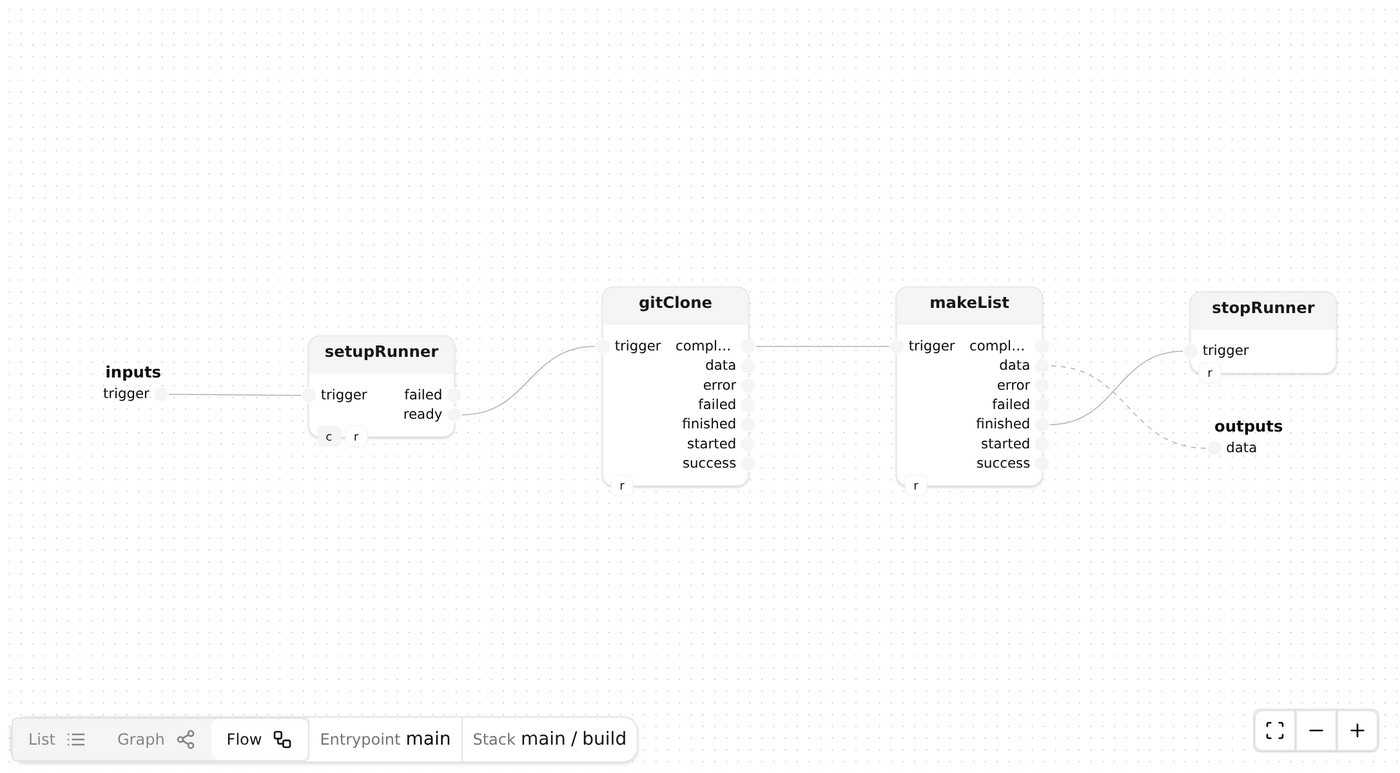
The build and test treatments are implemented the same way: they require to setup a runner, on which steps are distributed.
Their basic implementation is given as naive working example.
Both takes the CicdDispatchEngine model, and an input trigger signal. CicdDispatchEngine and input trigger are used to require a new distributed runner CicdRunnerEngine through setupRunner as soon as it is useful to get one ready.
treatment build[cicd: CicdDispatchEngine](repository_clone_url: string, repository_clone_ref: string)
  model runner: CicdRunnerEngine()
  input trigger: Block<void>
  output data:   Stream<byte>
{
    setupRunner[
        dispatcher=cicd,
        runner=runner
    ](
        name="build",
        cpu=10,
        memory=500,
        storage=1000,
        volumes=[|volume("build-result", 30)],
        containers=[|container("ubuntu", 1000, 10, 8000, |wrap<Arch>(|amd64()), [|mount("build-result", "/mounted/result")], "ubuntu:noble", _)]
    )
    gitClone: stepOn[runner=runner](
        name="git",
        executor_name="ubuntu",
        environment=|wrap<Environment>(|environment(|map([]), "/root", false, false)),
        commands=[
            |command("apt-get", ["update"]),
            |command("apt-get", ["install", "-y", "git"]),
            |command("git", ["config", "--global", "url.https://.insteadOf", "git://"]),
            |command("git", ["clone", "--branch", repository_clone_ref, "--depth", "1", repository_clone_url, "project"])
        ]
    )
    makeList: stepOn[runner=runner](
        name="list",
        executor_name="ubuntu",
        environment=|wrap<Environment>(|environment(|map([]), "/root/project", false, false)),
        commands=|raw_commands([
            "sh -c \"ls -l --almost-all | tee files-list.txt\"",
            "mv files-list.txt /mounted/result/"
        ]),
        out_filesystem="build-result",
        out_file="files-list.txt"
    )
    stopRunner[runner=runner]()

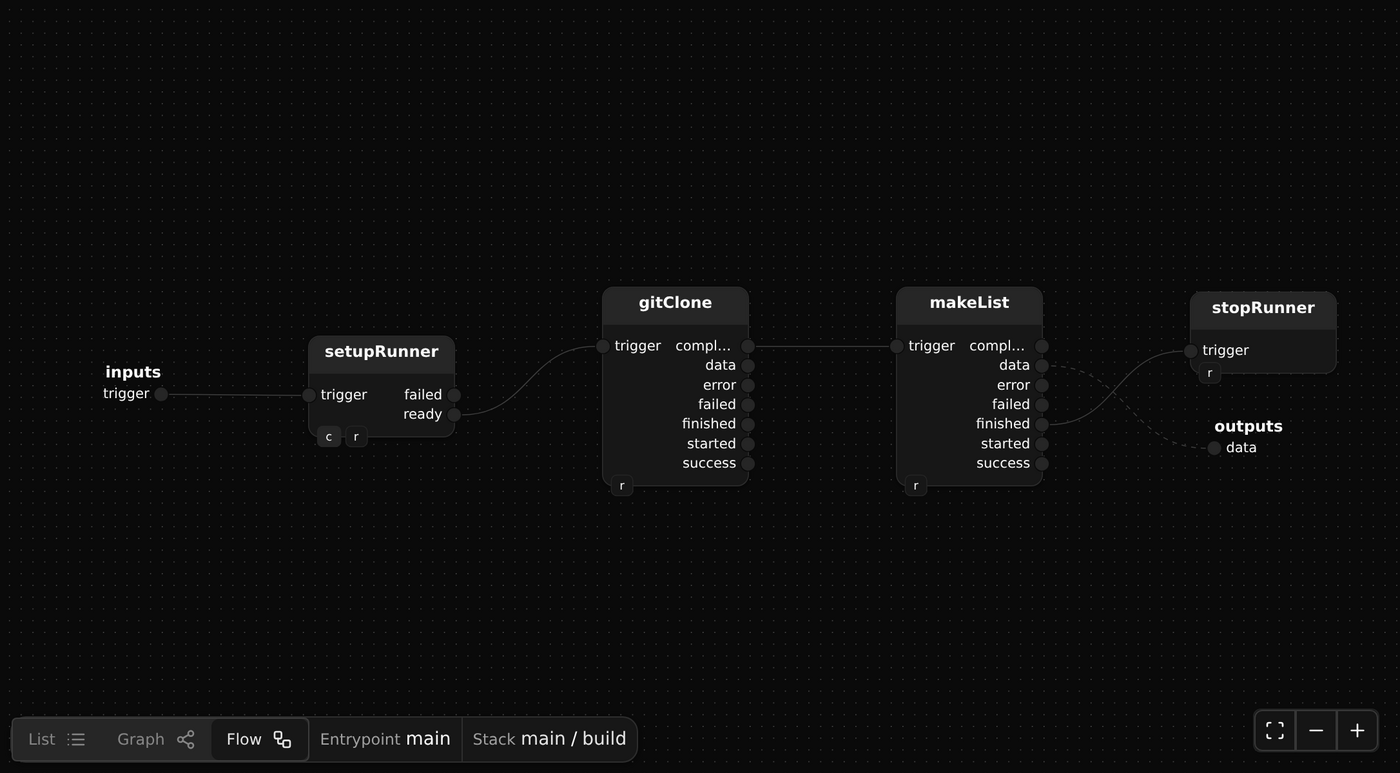
    Self.trigger -> setupRunner.trigger,ready -> gitClone.trigger,completed -> makeList.trigger,finished -> stopRunner.trigger
                                                                               makeList.data -------------> Self.data
}
Setup runner
setupRunner takes different parameters, the main ones are:
name, a string with which all logs will be marked;cpu, amount of CPU (in millicores,1000being one full CPU) the Mélodium engine must have;memory, memory (in megabytes) dedicated to the Mélodium engine;storage, disk space (in megabytes) the Mélodium engine has at disposal;volumes, array of volumes the Mélodium engine and containers can share on the runner;containers, list of containers that are available to run steps on the runner.
Volumes are basically labels associated with size (in megabytes), and can be mounted inside containers to share data with them. Containers are defined by the following:
|container(name, memory, cpu, storage, arch, mounts, image, pull_secret)namebeing the designated name with which the container can be adressed as executor;memory(in megabytes),cpu(in millicores) andstorage(in megabytes), in that order, having the same meaning as for the Mélodium engine;archdesignating the hardware architecture on which the container must run, as anOption<Arch>:_takes the architecture of the worker,|wrap<Arch>(|amd64())requires a specific one;mountsbeing an array of mounting points for defined volumes within the container filesystem;imagethe container image to use as base for the container;pull_secretthe (optional) registry credentials to pull the container image, aSecret<string>holding a Docker configuration JSON, given as a locator such as"env:MELODIUM_SECRET_REGISTRY".
The Mélodium engine itself can be quite frugal in resources as work in CI/CD is usually done within containers, leaving only the orchestration and data streaming work: the template gives it 10 millicores and 500 megabytes.
Currently the AMD64/x86_64
|amd64()and ARM64/aarch64|arm64()architectures are supported, and all the containers in the same runner that give one must use the same architecture.
All volumes together must fit within the Mélodium engine storage, and each container’s storage must be at least the sum of the volumes mounted in it. While CPU and memory values are cumulative among the main engine and containers, requiring the runner to have the sum of all the required capacities, the storage space corresponding to volumes is shared and not duplicated between containers.
Run steps
On every runner an arbitrary number of steps can be applied using the stepOn and stepOnWithInput treatments.
These treatments takes a CicdRunnerEngine, on which work will be done, according to the following logic:
- inputting data file (for
stepOnWithInput), - processing commands,
- outputting data file.
Inputting data
stepOnWithInput have two parameters setting up what data file is wrote: in_filesystem and in_file respectively tells what volume and what file name are filled with data coming from data input.
Here the file "list.txt" is wrote on filesystem volume "tested-data" and accessible on the mounting point "/mounted/data/" of executor "alpine":
makeTest: stepOnWithInput[runner=runner](
    name="test",
    executor_name="alpine",
    in_filesystem="tested-data",
    in_file="list.txt",
    commands=[
        |command("test", ["-s", "/mounted/data/list.txt"]),
        |command("cat", ["/mounted/data/list.txt"])
    ]
)
Processing commands
The commands parameter is a list of commands run on executor designated by executor_name within optionally-defined environment.
Commands can be specified in multiple ways:
|command()function, for a finely-detailed command and list of arguments;|raw_command()function, for a raw string command;|raw_commands()function, for full list of string commands.
environment can also be given, to specify additionnal environment variables or working directory.
The environemnt is applied on all commands of a given step.
gitClone: stepOn[runner=runner](
    name="git",
    executor_name="ubuntu",
    environment=|wrap<Environment>(|environment(|map([]), "/root", false, false)),
    commands=[
        |command("apt-get", ["update"]),
        |command("apt-get", ["install", "-y", "git"]),
        |command("git", ["config", "--global", "url.https://.insteadOf", "git://"]),
        |command("git", ["clone", "--branch", repository_clone_ref, "--depth", "1", repository_clone_url, "project"])
    ]
)
Outputting data
stepOn and stepOnWithInput treatments both allows to output any data. out_filesystem and out_file specify what volume and file is streamed after step commands.
Here the file "files-list.txt" is streamed from volume "build-result" after commands are run:
makeList: stepOn[runner=runner](
    name="list",
    executor_name="ubuntu",
    environment=|wrap<Environment>(|environment(|map([]), "/root/project", false, false)),
    commands=|raw_commands([
        "sh -c \"ls -l --almost-all | tee files-list.txt\"",
        "mv files-list.txt /mounted/result/"
    ]),
    out_filesystem="build-result",
    out_file="files-list.txt"
)
Execute CI/CD Locally
In order to run the CI/CD program, invoke Mélodium with program parameters.
export MELODIUM_API_TOKEN=<YOUR_RUN_TOKEN>
melodium run --api-report .melodium-ci/Compo.toml advanced --repository_clone_url <FULL_CLONE_URL>.git --repository_clone_ref <BRANCH_OR_TAG>
Where YOUR_RUN_TOKEN is a Cadence.CI run token. This executes the CI/CD “main engine” from your computer, and runs the build and test runners on machines Cadence.CI starts in your connected cloud account. Add --work_location compose to run them as local containers instead.
All the CI/CD logs are also shown in the terminal.