What Goes Through Cadence.CI
Cadence.CI coordinates the machines of a run and keeps its records. The work itself, the data your steps exchange and your secrets stay on your side: on the machine where you launch the pipeline and on the instances in your cloud account.
Your side
Engine you launch
On your laptop or in a CI job.
Machines in your cloud account
One per step, started and stopped by Cadence.CI.
Cadence.CI
Coordinates the machines and keeps the run records. Secrets appear only by name and type, never by value.
What Cadence.CI Receives
| Data | Sent when | Visible to |
|---|---|---|
| Run status: requested, started, finished, result | Every reported run | Organization members |
Entrypoint and parameter values. A Secret parameter appears only as its name and type, never its value | Every reported run | Organization members |
| Logs, with any secret value masked | Every reported run, in chunks while it runs | Organization members |
| Debug events, which never contain secret values, at any level | Every reported run, at the basic level unless set otherwise with --debug-level | Organization members |
| Program: the Mélodium pipeline that ran, not your application code | Every reported run | Organization members |
| Resources requested: CPU, memory, storage, architecture, container image names | Every reported run | Organization members |
| Instances started: provider, type, zone, IP addresses | Runs on a connected cloud account | Organization members |
| Cloud account credentials | When you connect a cloud account | Used by Cadence.CI to start and stop instances, never shown again |
On the open-source plan, runs, their logs and their program are public; debug events stay visible to members only.
Retention follows your plan: 7 days on Access, 120 days on Basic and on the open-source plan, one year on Pro, custom on Enterprise.
Secrets
Credentials are values typed Secret. You give them as locators, never as values:
env:MELODIUM_SECRET_<NAME>reads an environment variable whose name starts withMELODIUM_SECRET_;file:<path>reads a file.
The engine that needs a secret resolves it on its own machine. Cadence.CI only ever learns that a secret exists, by its name and type: in the parameters, the program and the debug events. Logs mask any secret value a step might print. The one exception is a value your own program turns back into plain data with reveal; secrets read from environment variables and files can never be revealed that way.
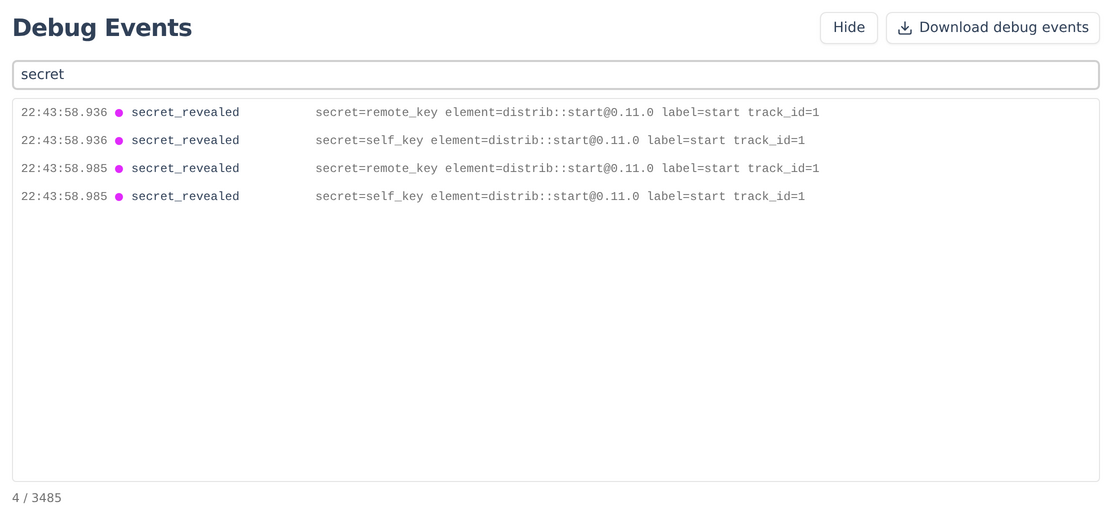
The secret audit in the debug events, above, records which element used which secret, and nothing more: here, the two keys that secure the connection to each step’s machine.
What Stays on Your Side
- Data between steps. Files and values streamed from one step to another go directly between the engines. Cadence.CI gives the engine a runner’s address; it does not relay the traffic.
- Secret values. Resolved where they are used, never sent to Cadence.CI.
- Your cloud account. Instances, images and network stay in your account. Cadence.CI acts through your provider’s API, with the permissions you grant when you connect the account.
Going Further
- Where It Runs: the options for launching the engine and running the steps.
- Integration with Cloud Providers.